
Gobi Desert Highlights & Central Mongolia
Day-by-Day Itinerary
Ulaanbaatar → Tsagaan Suvarga (White Stupa Cliff)
Depart Ulaanbaatar early in the morning and travel south into the vast Gobi region. Watch the cityscape give way to endless steppe, with rolling grasslands, remote nomadic settlements, and herds of horses, sheep, goats, and camels along the way. In the afternoon, arrive at the magnificent Tsagaan Suvarga, a colorful limestone escarpment formed millions of years ago when the area was covered by an ancient sea. Its layered cliffs of white, pink, orange, and red resemble the ruins of an ancient city from a distance. Walk along the dramatic viewpoints and witness a spectacular sunset that turns the desert gold and crimson, before settling into your ger camp for dinner and a night beneath a sky full of stars.
Tsagaan Suvarga → Yol Gorge (Vulture Valley)
Travel to Yol Gorge (Yolyn Am), hidden within Gobi Gurvansaikhan National Park. Despite sitting in the middle of the Gobi, the gorge's high surrounding mountains create a cool microclimate all its own, and ice can remain in the canyon well into the summer months. Hike the trail between its towering rock walls, keeping an eye out for wildlife including ibex, argali sheep, and the bearded vultures that give the valley its name. After the open desert of the day before, the narrow, sheltered gorge feels like a different world entirely.
Yol Gorge → Khongor Sand Dunes
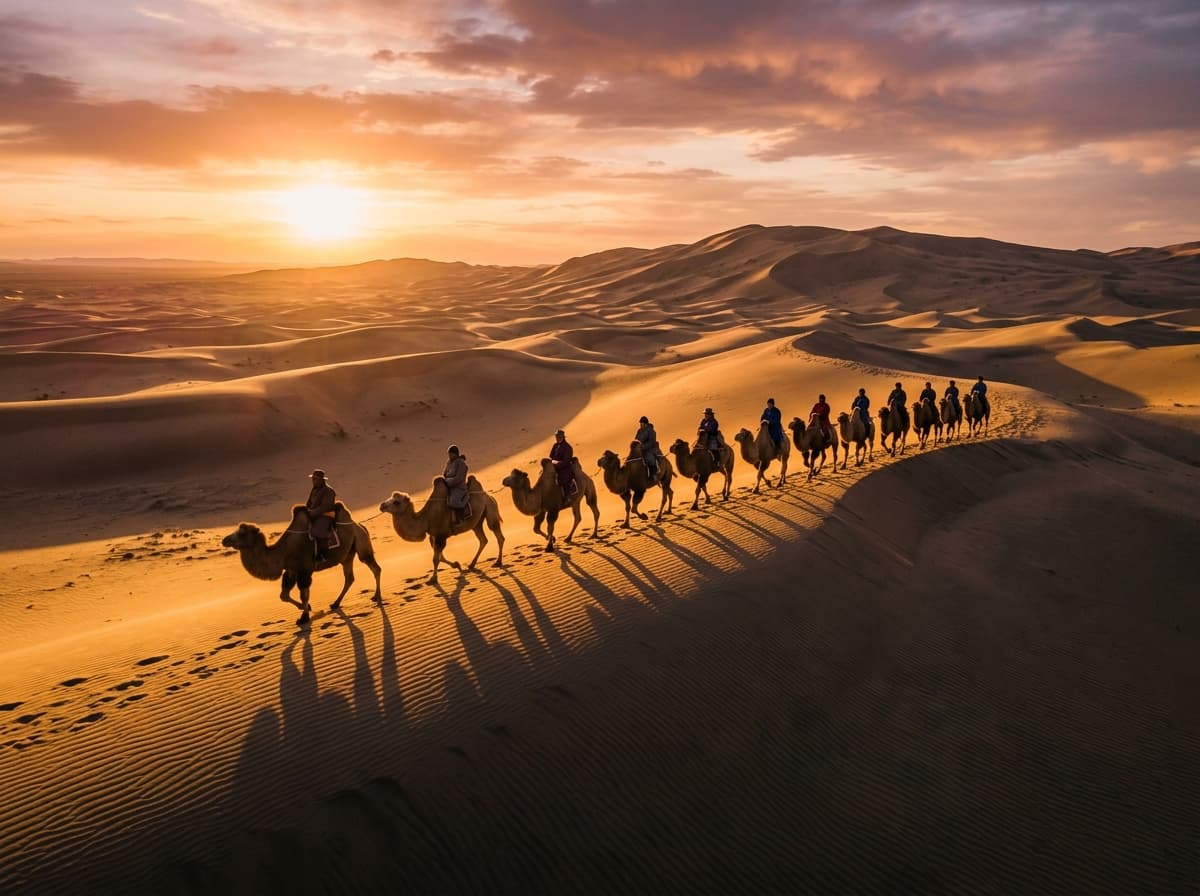
Journey to the spectacular Khongor Sand Dunes, known as the 'Singing Dunes' for the deep humming sound that shifting sand can produce underfoot. Rising up to 300 meters (984 feet) and stretching roughly 100 km, these are among Mongolia's largest dune systems. Climb partway up the slopes or walk barefoot across the warm sand, visit a local camel-herding family, and enjoy a camel ride before climbing higher for panoramic views and an unforgettable sunset over the dunes.
Khongor Sand Dunes → Bayanzag (Flaming Cliffs)
Visit the world-famous Flaming Cliffs of Bayanzag, where American paleontologist Roy Chapman Andrews's 1920s expedition discovered some of the first fossilized dinosaur eggs ever found. Explore the striking red sandstone formations, named for the brilliant reddish orange glow they take on near sunset, and learn about Mongolia's rich paleontological heritage.
Bayanzag → Ongi Monastery
Travel north to the peaceful ruins of Ongi Monastery, once one of Mongolia's largest Buddhist monasteries with more than a thousand resident monks before it was destroyed during the political purges of the 1930s. Explore the slowly restored temples on both banks of the Ongi River and enjoy the tranquil scenery of one of the Gobi's quieter, more reflective stops.
Ongi Monastery → Karakorum
Continue to Karakorum, the 13th-century capital established by Ögedei Khan, son of Genghis Khan, at a crossroads of the Silk Road. Visit Erdene Zuu Monastery, built in 1586 partly from the stones of the old capital's ruins, and the Karakorum Museum to learn about the rise and fall of the Mongol Empire's first great city.
Karakorum → Khustai National Park → Ulaanbaatar
Travel to Khustai National Park, home to the Takhi, the world's only truly wild horse species. Once extinct in the wild, the Takhi were reintroduced to Khustai starting in the 1990s from a small number of zoo-bred survivors, and the park's population has grown steadily ever since. Enjoy wildlife viewing across the park's rolling grasslands before returning to Ulaanbaatar in the evening, bringing your Gobi expedition to a close.